
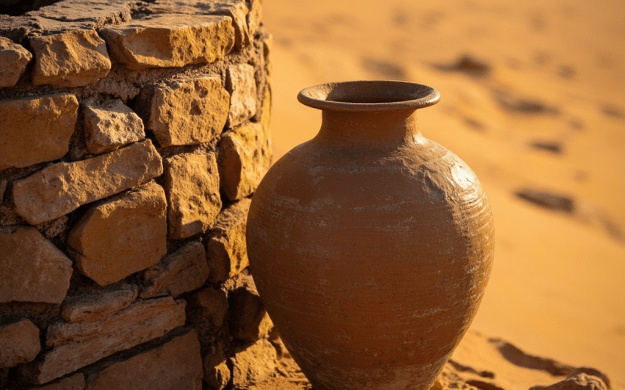
This story begins with thirst. Dusty roads. Weariness. Heat. Empty water jars in need of filling.
Jesus and His disciples are traveling away from Judea toward Galilee. Most devout Jews would have taken a longer route to bypass Samaria in order to avoid the half-breed, socially disdained Samaritan people who were at odds with pure Jews. Jesus did not. He said that He needed to pass through Samaria. In John 4, we find him alone, resting beside Jacob’s well- worn out and thirsty.
The author tells us that it was about the 6th hour, or noon, when a Samaritan woman came to draw water. The timing of her trip to the well tells us a lot about her status, even among the despised Samaritans. She was a woman living in shame. The kind of shame that makes you want to keep to yourself. The kind of shame that makes you avoid the other women who would have drawn water in cool of the morning or evening. Our girl is taken by surprise when Jesus asks her to draw water from the well and give Him a drink. This was not done in Jewish culture. He was breaking all kinds of cultural norms. She questions him on it. How can he, being Jewish, ask her- a female, and a Samaritan female at that, for a drink? She knew her rank in relation to him. She could not have been any lower on the social scale.
Jesus answers her by saying that if she knew who she was talking to, she’d be asking him for a drink of living water. She responds by asking him how he could provide living water with no bucket, and also, what water could be better than water from this well? Was he implying he was greater than Jacob?
He responds and tells her that the water he offers would become a spring of life and those who drink, never thirst again. Satisfied.
Surprised, she asks him for this water, but he comes back at her with a request. He asks her to call her husband. She tells him she is not married. He then proceeds to tell her that she is right. She has had five husbands, and her current man is not her husband at all. Here is something that we often miss. A woman in that day could not divorce her husband. She could only be divorced by her husband if he found some kind of fault in her, which could range from dissatisfaction with her appearance, to barrenness, to infidelity, to just about any reason the husband chose. We are not told what the reasons were. What we do know is that this girl had been rejected by her most intimate relationship for whatever reason five times. Five times picking up the pieces of a broken life. Five times wondering how she would survive financially. Five times dealing with the fact that she was not worthy to be loved, cherished and chosen. And now, she was done. No more marriage. She was living with a man. Dealing with the shame of that by slipping out in the heat of the day to avoid other people and their censure. And this stranger somehow knew all of that as he sat with her by the well. How?
Her stunned reply was that she thinks he is a prophet. Then she tries to shift the conversation to places of worship. Samaritans worshipped on Mount Gerizim. Jews worshipped in Jerusalem. That should do the trick. Jews and Samaritans would fight over this one. Maybe this would take his attention off her heart. What Jewish man didn’t love to argue about worship? Apparently this one. He did not take the bait.
Spirit and Truth. Those were the words he went on to use describing the kind of worshippers God was looking for. Not location. Not tribe. Not ethnicity. Spirit and Truth.
Unable to comprehend what he could mean by that, she told him that when the Messiah came, he would explain it all.
Jesus responded to her with the most audacious claim. He made a statement that would set the religious against him with seething violence. A statement that removed all doubt as to who he was and why He came. He said, “I who speak to you am He.” This was the first time He had spoken that truth so directly and plainly. After hundreds of years of Messianic expectation, He chose to first share it with her at a dusty, hot well. Not at the at the temple, or synagogue. Not to the religious. Not to the powerful or the wealthy. Not to the ethnically pure or to those welcomed in their own communities. Just to her. A woman rejected by almost everyone in her life. A woman without the right marital status. Without the right connections. Without the moral high ground. Without the right ethnicity or gender. A woman too ashamed for friendship. She was the one He chose.
She was why He needed to pass through Samaria. Because He knew that she needed Him.
This story closes with dusty roads again as she goes back into her community emboldened by Jesus and engages the very people she had been trying to avoid. Her shame encountered Jesus and became her story. She had come to the well, empty and ashamed. She left filled and changed.
That is her story. It is the story of all of us who have encountered the God who comes for us, the ones nobody else would have come for, and gives us honor in place of shame.
Welcome to the Well.
 willnotbetaken